ParallelMCMC.jl

ParallelMCMC.jl is a Julia package for parallel-across-the-sequence MCMC — algorithms that solve an entire trajectory of $T$ correlated steps simultaneously rather than one at a time.
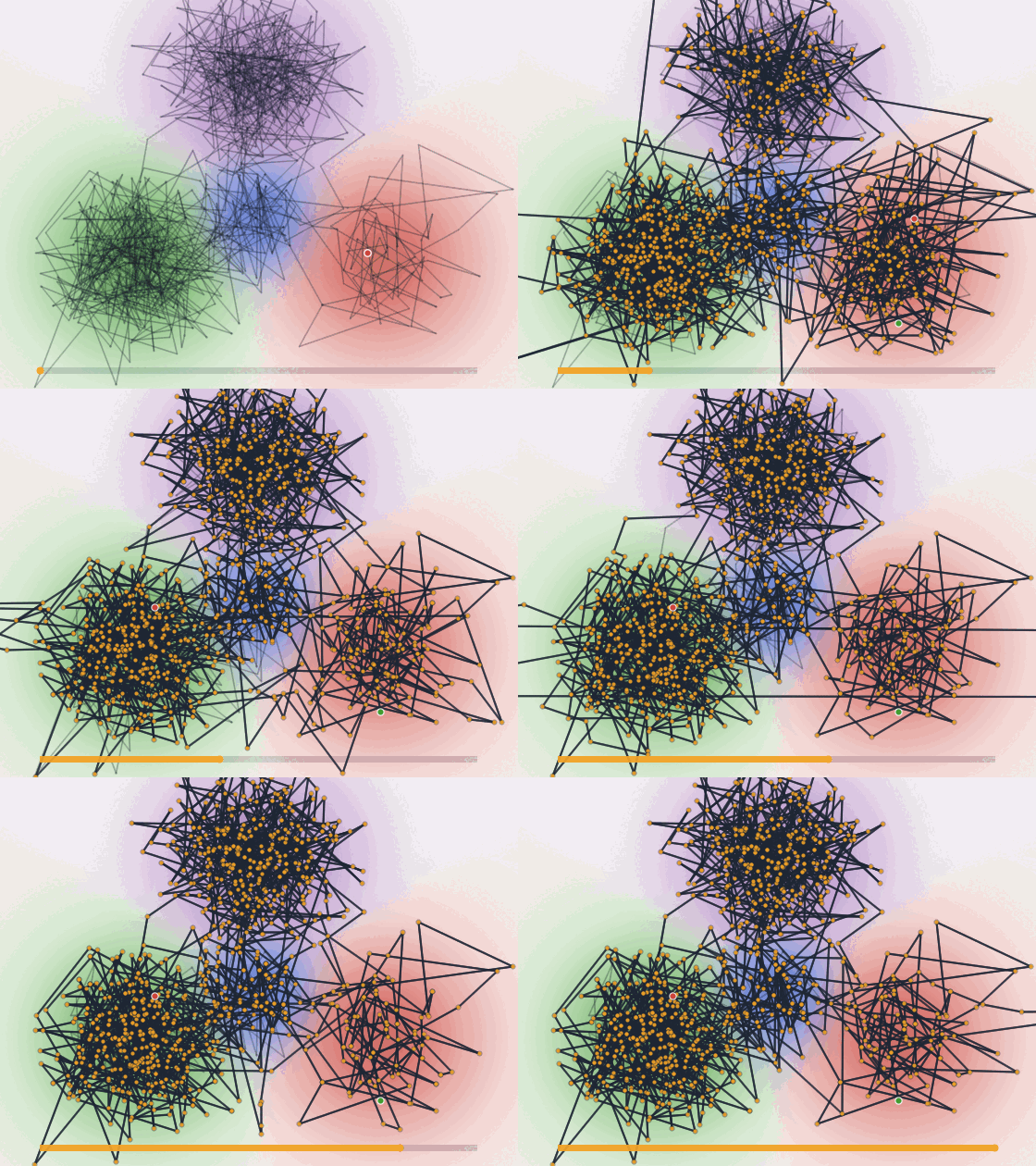
DEER iterates on a synthetic Julia-logo-shaped posterior: orange trajectory estimates move toward the taped MALA path over repeated trajectory solves.
The flagship algorithm is DEER (Deterministic Equivalent-Expectation Recursion), which reformulates a chain of $T$ MALA steps as a fixed-point problem and solves it via Newton iterations, each costing $O(\log T)$ parallel work via an associative prefix scan. The result is that wall-clock time per sample is sublinear in chain length on multi-core CPUs and GPUs.
The algorithm is described in:
Zoltowski, D. M., Wu, S., Gonzalez, X., Kozachkov, L., & Linderman, S. W. (2025). Parallelizing MCMC Across the Sequence Length. NeurIPS 2025. arXiv:2508.18413
The included MALASampler and AdaptiveMALASampler are sequential MALA baselines — useful for correctness checks and step-size tuning, but not the primary focus of the package.
Samplers
| Sampler | Role |
|---|---|
ParallelMALASampler | Primary — parallel-across-sequence MALA via DEER; O(log T) per solve |
MALASampler | Baseline — sequential MALA with a fixed step size |
AdaptiveMALASampler | Baseline — sequential MALA with dual-averaging step-size adaptation |
All samplers implement the AbstractMCMC interface and return FlexiChains objects.
Installation
To install the package into your current environment:
pkg> add ParallelMCMCQuick start
Define a model
The simplest entry point is DensityModel, which wraps a log-density and its gradient:
using ParallelMCMC, FlexiChains
using ADTypes, Enzyme

# Example: 2-D standard normal
logp(x)      = -0.5 * sum(abs2, x)
grad_logp(x) = -x

model = DensityModel(logp, grad_logp, 2;
                     param_names=[:x1, :x2])
DEER — parallel-across-sequence (primary algorithm)
sampler = ParallelMALASampler(0.1; T=64, jacobian=:stoch_diag,
                              backend=AutoEnzyme())

chain = sample(model, sampler, 500;
               chain_type=VNChain)
Each call to sample draws 500 samples by solving DEER trajectories of length T=64 in parallel, re-solving from the last state when each trajectory is exhausted.
Specifying chain_type=VNChain returns a FlexiChain{VarName}, which has a parameter type of VarName. This is intended for maximum ease of use; however, if you prefer parameter type of Symbol you can use SymChain instead. See the FlexiChains.jl docs for more information about how to analyze and visualize chains.
Sequential MALA baseline
sampler = AdaptiveMALASampler(0.1; n_warmup=500)

chain = sample(model, sampler, 2_000;
               chain_type=VNChain,
               discard_warmup=true,
               progress=true)
Turing.jl integration
When DynamicPPL (part of Turing.jl) is loaded, a one-argument DensityModel constructor is available that wraps a @model directly. Parameter names are automatically extracted, and values transformed back to the original model space:
using Turing, ParallelMCMC, FlexiChains

@model function normal_model(y)
    μ ~ Normal(0.0, 1.0)
    y ~ Normal(μ, 0.5)
end

model   = DensityModel(normal_model(1.5))
sampler = AdaptiveMALASampler(0.3; n_warmup=500)

chain = sample(model, sampler, 2_000;
               chain_type=VNChain,
               discard_warmup=true)
See Getting Started for worked examples and guidance on choosing samplers, and Algorithm Details for the mathematics behind DEER.
For Turing models the chain type used must be VNChain (not SymChain), as that is the natural parameter type for Turing models.
Contributors
 Ryan Senne 💻 🚧 ⚠️ 🤔 👀 📖 |
 Penelope Yong 💻 ⚠️ 🤔 👀 📖 |
 Guillaume Dalle 👀 🤔 |
 William Moses 👀 |